BuffaloWildWings

  • Subscribe to our RSS feed.
  • Twitter
  • StumbleUpon
  • Reddit
  • Facebook
  • Digg

Monday, November 5, 2012

Nine Ways the US Democratic System Screws its Cities

Posted on 7:04 AM by Unknown
No, I'm not talking about the usual anti-urban Federal subsidies. I'm not mentioning pro-sprawl policies like the US interstate highway system, FHA redlining, the mortgage interest deduction, the low gas tax, or the uneven geography of military spending. Those are all political outcomes, things that happen (mostly) fair and square through our system of representational democracy.

What I'm talking about here are political inputs. These are ways that the traditional (as of the mid-20th century) one-person one-vote system of democracy is skewed against cities, in favor of rural and suburban (largely white) America. The game is rigged against urban life, against the very places where the most people live.  Jeffersonian agoraphobia lies at the very heart of our constitutions and procedures.

Here they are, in order of least to most egregious:


Map Projections:
This may seem like small potatoes, but its sets the table for the meal of undemocracy you’re about to enjoy. When you glance at a US electoral map on the television, you see an ocean of red surrounding tiny islands of blue. It makes it seem like a vast conservative majority is somehow outweighed by little blue measles. In reality, it's the other way around. These maps reflect the basic American imbalance between population and geography that makes it so difficult to have fair representation in our vast and sprawling country.
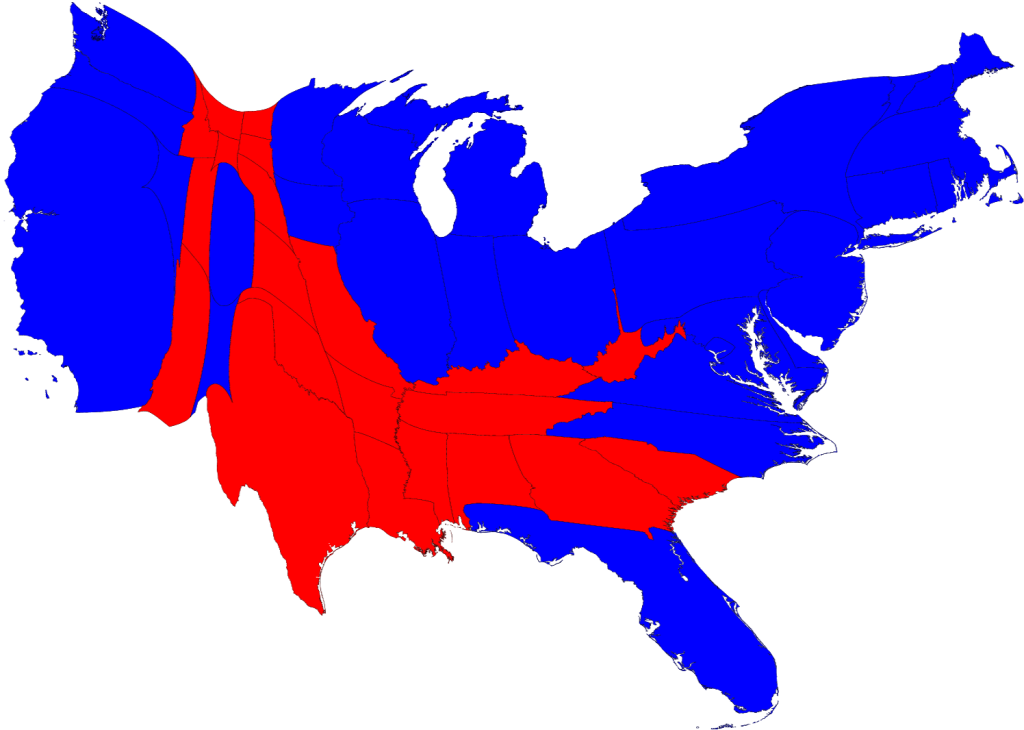
[A population cartogram that reflects the true weight of the 2008 presidential race.]


Primary Elections: In our presidential primary system, New Hampshire and Iowa are the “first in the nation” to vote. These places get a disproportionate amount of attention from ambitions politicains. They are also places with almost zero cities. (No offense, Davenport!) This system is stupid for lots of reasons, but privileging the rural is one of them.

Locations of State Capitols: Harrisburg, Springfield, Albany, Sacramento... These are not the largest cities in America. When deciding where to put state capitals, back in the early days of the USA, those in power chose to locate them far away from the major cities. There were some good reasons to do this, because cities were extremely corrupt. But one goal was also to minimize the potential for grassroots democracy. It’s a lot harder to protest when you’re three hundred miles away. The kinds of direct action tactics that occurred in Madison, Wisconsin two years ago would never have happened if the state capitol was in Marinette, up on the Michigan border.

[Albany, New York: located far from the maddening crowd.]
 

District of Columbia: Our nation’s capital is also one of nation's largest travesties of democracy. It has no official representation in congress. By complete coincidence, DC is terribly poor and disproportionately home to people of color. It’s basically a microcosm of how the American political system screws its cities and black people. If DC were an official state, it would have two senators, but it still wouldn’t be the least populous. That honor would still belong to Wyoming.
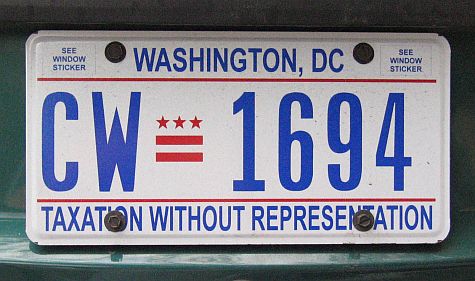
[The best license plate in the country.]


Lack of Competitive Districts: Almost without exception, competitive races are out in the suburbs or in rural areas. It only makes sense that, given this system, parties that are trying to win a majority  will promote federal policies that benefit more competitive districts. Thus, you get a military base or freeway project or some other other white meat out in the swing suburbs. Meanwhile, politicians in urban districts are absolute locks for re-election. They can go ahead and spend more of their time concentrating on building a national majority (which means catering to suburban and rural voters).

Redistricting: When faced with the political clout of many people living in a city, a hostile state government is not without options. One popular choice is redistricting, drawing the boundaries of the districts to minimize and/or ‘pack’ urban areas. Sometimes that means creating the aforementioned highly uncompetitive districts. Sometimes that means drawing districts like the ones in Cincinnati or Austin, dividing up urban areas like slices of a delicious undemocratic pie. 
[I don't understand this, and neither do you, but it screws Cincinnati.]


Polling Places: In the US, local jurisdictions are responsible for running polling places. Often this means that voting is more difficult and time consuming in urban areas. For the last few decades, Ohio and Florida have been particularly unequal. Having to wait in line for 10 hours to cast your ballot, while people in rural and exurban neighborhoods vote smoothly, is one outcome of our election system. Intentional or not, it does no favors to our cities.
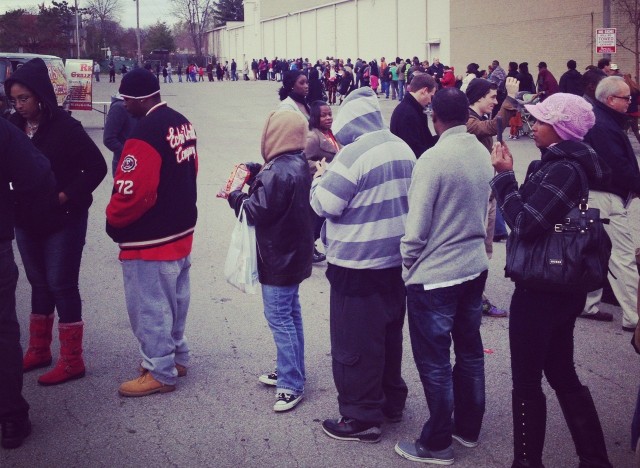

[A line for early voting in Miami-Dade county from yesterday.]


Electoral College: It’s a little known fact that someone voting for president in Montana gets three votes, while someone voting for president in California only gets one. OK, that’s not technically true, but it may as well be. Our fossilized electoral college system allocates votes unfairly, and disproportionately to states with low population. In Wyoming and North Dakota, there is one electoral vote for every 140K people. In Florida and New York, these is one electoral vote for every half million people. Where do you think the cities are?

[Your presidential vote is weighted according to your misanthropy.]

The US Senate: Congress has two bodies. One of them is extremely unfair. Wyoming gets two senators, each representing a population of 568,000. California also gets two senators, each representing a population of 37,691,000. On top of this travesty, Senators are very powerful. They have long terms and are given the power to wield the the anti-democratic (increasingly abused) filibuster. As Hendrick Hertzberg explains, 10% of the population (the senators from the most rural states) can effectively block the will of the vast majority of the people. This means that passing a (pro-urban) bill through the Senate can technically require a ‘supermajority’ of 90% of the people. The undemocratic Senate holds our cities hostage to the demands of farmers and industry from our most remote places.

[Mr. Smith goes to Washington, screws the people.]


There you have it. Have fun voting tomorrow. Try not to live in a city, though, because your vote won’t be as important. If you really want to affect your nation's democratic system, call your old aunt Agnes in Beach, North Dakota. Her vote is worth double.
Email ThisBlogThis!Share to XShare to FacebookShare to Pinterest
Posted in cities, democracy, politics, public policy, USA | No comments
Newer Post Older Post Home

0 comments:

Post a Comment

Subscribe to: Post Comments (Atom)

Popular Posts

  • *** Sidewalk Weekend! ***
    Sidewalk Rating: Pit-stained You pass by six-storied houses, in which sixty or seventy families harbor, and swelter in the boundless contig...
  • Six Things Rapidly Becoming Obsolete
    Lost in the automobile buzz over robo-cars is the debate over Tesla Motors ' attempts to sell cars over the internet. To me, Tesla, whic...
  • Reading the Highland Villager #78
    [Basically the problem is that the best source of Saint Paul streets & sidewalks news is the Highland Villager, a very fine and historic...
  • TCSidewalks Live: Bike the New Brewpubs of Minneapolis Tonight
    [Some bearded dude (typical) on the Harriet  taproom patio, which is in a great alley!.] I'm going to be co-hosting a ride to five brew...
  • Nine Ways the US Democratic System Screws its Cities
    No, I'm not talking about the usual anti-urban Federal subsidies. I'm not mentioning pro-sprawl policies like the US interstate high...
  • *** Sidewalk Weekend! ***
    Sidewalk Rating: Timeless --> Then usual drive home: zone of used car dealerships, zone of quarry, long stretch of highway looking ...
  • Ignorant Thoughts on Bicycling in Boston
    [One-way "No Bikes" street near Harvard Square.] OK, first of all, I have never ridden a bicycle in Boston. That said, I was just ...
  • Classic Sidewalks of the Silver Screen #81
    Alvy breaks up with Annie... ... in Woody Allen's (1977) romance, Annie Hall .
  • Sidewalk of the Week: 34th Avenue South
    The other day I happened across the holy grail of sidewalk wandering: the perfect corner. Some friends had called a meeting at a local dive ...
  • Cities and Inner Life
    [Young's work involves performative walking.] A few weeks ago, I found myself at an all-day retreat meeting in downtown St Paul to discu...

Categories

  • #WARONCARS (3)
  • aesthetics (4)
  • affordable housing (1)
  • alleys (3)
  • animals (5)
  • announcement (9)
  • architecture (3)
  • archives (1)
  • art (11)
  • baseball (1)
  • beer (8)
  • bicycle freedom week (3)
  • bike parking (4)
  • bikes (27)
  • birds (1)
  • blogging (3)
  • Boston (11)
  • bureaucracy (2)
  • BURP (2)
  • capitalism (3)
  • cars (9)
  • Chicago (9)
  • cities (13)
  • cities on the move (1)
  • classic sidewalks of the silver screen (21)
  • Climate Change (2)
  • cobblers (1)
  • conspiracy (3)
  • crime (2)
  • crowds (3)
  • Death (15)
  • democracy (3)
  • denny hecker's abandoned car lots (1)
  • density (6)
  • detroit (1)
  • diversity (4)
  • dives (1)
  • doorways (3)
  • downtown (7)
  • duluth (2)
  • economics (3)
  • edina (3)
  • environment (1)
  • everyday life (4)
  • falcon heights (1)
  • feedback (1)
  • florida (2)
  • food (4)
  • freedom (4)
  • gentrification (1)
  • geography (1)
  • god (2)
  • guns (1)
  • halloween (3)
  • hastings (2)
  • hennepin county (3)
  • historic preservation (4)
  • hopkins (1)
  • India (1)
  • industry (1)
  • infrastructure (3)
  • internets (1)
  • Jane Jacobs (1)
  • kids (3)
  • LA (9)
  • London (2)
  • love (1)
  • LRT (2)
  • mark dayton (2)
  • message boards (3)
  • Met Council (2)
  • metaphors (1)
  • milwaukee (1)
  • Minnesota (9)
  • modernism (2)
  • Mpls (93)
  • MPR Decoder (1)
  • music (1)
  • name that sidewalk (4)
  • nature (3)
  • neon signs (4)
  • newsflash (33)
  • NIMBY (9)
  • nostalgia (1)
  • NYC (6)
  • old people (3)
  • parades (2)
  • paris (1)
  • parking lots (6)
  • parking meters (3)
  • parks (1)
  • patios (1)
  • Philadelphia (7)
  • pittsburgh (1)
  • placemaking (2)
  • planning (12)
  • plazas (2)
  • politics (13)
  • pontification (5)
  • poor people (1)
  • portland (2)
  • postmodernism (1)
  • pothole pawlenty (3)
  • prognostication (2)
  • public health (1)
  • public policy (10)
  • public space (2)
  • public works (2)
  • pumpkins (1)
  • race (1)
  • ramsey county (1)
  • reading the highland villager (31)
  • real estate (1)
  • real world planning experiments (2)
  • retail (1)
  • rhode island (1)
  • richfield (1)
  • rivers (2)
  • safety (11)
  • San Francisco (2)
  • schadenfreude (2)
  • science (1)
  • seattle (1)
  • semiotics (3)
  • shop windows (5)
  • sidewalk closed signs (1)
  • sidewalk flotsam (1)
  • sidewalk games (13)
  • sidewalk of the week (10)
  • sidewalk poetry (18)
  • sidewalk vendors (1)
  • sidewalks (5)
  • sidewalks at night (1)
  • Sidewalks of Target Field (1)
  • signs of the times (24)
  • silly (2)
  • skyways (4)
  • snark (2)
  • soapboxes (1)
  • social capital (2)
  • southern MN (1)
  • stillwater (3)
  • stpaul (98)
  • street musicians (5)
  • streetcars (2)
  • streets.mn (19)
  • suburbs (3)
  • subways (1)
  • tcs interviews (2)
  • TCSidewalks Live (4)
  • the media (8)
  • the Midwest (1)
  • the South (1)
  • traffic (3)
  • traffic calming (2)
  • trains (2)
  • transit (5)
  • Transportation (3)
  • trees (1)
  • U of MN (6)
  • UK (1)
  • upstate NY (1)
  • USA (3)
  • walkability (6)
  • Washington DC (1)
  • weather (6)
  • Wisconsin (5)
  • woodbury (1)
  • worst planning contest (1)
  • zombies (2)

Blog Archive

  • ►  2013 (176)
    • ►  September (11)
    • ►  August (21)
    • ►  July (19)
    • ►  June (17)
    • ►  May (24)
    • ►  April (21)
    • ►  March (13)
    • ►  February (25)
    • ►  January (25)
  • ▼  2012 (124)
    • ►  December (14)
    • ▼  November (12)
      • Reading the Highland Villager #72
      • HELP WANTED Camera is broken
      • *** Sidewalk Weekend! ***
      • Reading the Highland Villager #71
      • What's the Best Possible Scenario for Minnesota Ci...
      • Signs of the Times #63
      • TCS Interviews George and Betty, Members of the Sa...
      • Today on Streets.mn: Do Sidewalks Turn People Into...
      • Nine Ways the US Democratic System Screws its Cities
      • *** Sidewalk Weekend! ***
      • Classic Sidewalks of the Silver Screen #90
      • George Romney shapes West Bank Minneapolis, circa ...
    • ►  October (25)
    • ►  September (26)
    • ►  August (27)
    • ►  July (20)
Powered by Blogger.

About Me

Unknown
View my complete profile